![[FF Logo]](/layout3/images/logo.png)
Lesson Objectives:
Learn the basics of using your cervix position as an optional fertility sign.
Learn how to observe and record your cervix position sign.
Major Points in this Lesson:
Cervix Position (CP) is a secondary, optional fertility sign.
The cervix changes throughout the menstrual cycle in response to the hormone, estrogen.
During non-fertile times, the cervix is closed, firm and low.
As ovulation approaches and fertility is high, the cervix opens up, becomes soft and high and is harder to reach.
More...
Just as increased estrogen causes the production of fertile cervical fluid that aids conception by promoting sperm nourishment and migration, estrogen also produces observable changes in the cervix that also facilitate conception. To allow the passage of sperm from the cervix into the uterus, the cervix opens, softens, and heightens before ovulation. After ovulation, the cervical os closes, returns to a lower position, and the cervical tissues again become firmer.
Your cervical position is an optional, secondary fertility sign. It provides the same kind of information as cervical fluid (estrogen presence) so is not strictly essential if your cervical fluid signals are clear. Some women like to check the cervix position for cross-checking or when cervical fluid observations are unclear. Whether you choose to check your cervix position or not, read on to understand how the cervix changes during the menstrual cycle.
Early in your cycle, during and just after menstruation and prior to peak fertility when your estrogen level is low, your cervix is low, hard, firm and closed and easy to feel with your fingers. Your cervix lifts and straightens and becomes softer, higher and more open as your fertility (and the presence of estrogen) increases.
These cervical changes make the cervix more receptive to sperm and allow them to enter your reproductive tract and travel into the fallopian tubes where an egg may be fertilized. After ovulation, your cervix again becomes more closed and firm and lower.
Though this fertility sign is considered optional, checking your cervical position can provide useful information about your state of fertility. The changes in the cervix can be used to double-check observations made from checking BBT and cervical fluid.
It may take a few cycles to notice the changes your cervix experiences throughout your fertility cycle. It is a good idea to check when you know you are fertile (as indicated by your cervical fluid or cycle statistics or a positive OPK) and then again when you know you are not fertile (as indicated by your thermal shift in your luteal phase) when you are getting started. With this correlation, you will more easily feel the differences between your fertile and non-fertile times.
When you are approaching ovulation, your cervix will be high and soft. You may or may not notice that it feels more open also. When you are no longer fertile, your cervix will feel lower, more firm and you may notice that it is more closed.
If you are not comfortable checking your cervix or you find the changes difficult to observe, and you are able to observe your cervical fluid easily, checking your cervix is not absolutely essential. If you are comfortable checking your cervix and are able to identify changes, you will benefit from the additional information that will help cross-check your other signs.
If you choose to check your cervical position as an indicator of fertility, here are some guidelines:
To avoid the possibility of infection, always check your cervix with clean hands.
Check the cervix once a day after menses. You only need to check once a day, unlike cervical fluid which you may check several times a day.
Check your cervix at the same time every day as it may change throughout the day.
Use the same position for checking your cervix throughout the cycle as changing positions will change your observation of cervical height.
Empty your bladder before checking your cervix.
Squatting or placing one foot on a stool (or toilet seat) are good positions.
Relax. (You will be able to more easily relax as you gain more experience).
Insert one or two fingers into the vagina. At the back of the vagina, you should be able to feel your cervix. You have found your cervix when you feel something at the back of your vagina that stops your fingers. If you apply gentle pressure you will notice that it feels smooth, round and firmer that the surrounding vaginal tissues.
Feel your cervix and make the following observations:
Is the cervix high or low? (It is more difficult to reach when it is high.)
Does the cervix feel soft or firm?
Does the cervix feel open or closed? (Women who have already had children may notice that the cervix always feels slightly open.)
Does the cervix feel wet or dry?
Record observations.
You can record the position, firmness, and openness of your cervix.
Position: Your cervical position may be: low, medium or high. Your cervix heightens and becomes harder to reach as you approach your most fertile time. The important thing is to notice how it changes throughout your cycle in relation to your fertility. Observations can be subjective so you need to notice your own unique changes. Notice the change relatively. This may take a few cycles to really notice.
Low: Record "low" for your least fertile cervical position. This is the position where it is easiest to feel and reach your cervix.
Medium: Record "medium" for the position between your lowest and highest.
High: Record "high" when your cervix is hardest to reach. You may not even be able to reach it. You will notice that it feels more wet, soft and open at this time as well. This is your most fertile cervical position.
Firmness: Again, the issue is to notice the changes in the texture of your cervix relatively throughout your cycle as it transforms. Like your cervical position, it may take a few cycles to notice your own pattern. To get an idea of what you are looking for, check when you know you are fertile (when you have egg white cervical fluid) and when you are sure you are not (after ovulation has been confirmed by three high temperatures) so that you know what you are looking for. At your least fertile time, both before and after ovulation, your cervix will feel the most hard and firm, a bit like the tip of your nose. As you approach ovulation, your cervix will soften, feeling more like your lips. You can record the firmness of your cervix as Firm, Medium, or Soft.
Firm: Record "firm" as the most hard and firm texture you experience throughout your cycle. Your cervix will likely also be low and quite easy to reach at this time.
Medium: Record "medium" when your cervix feels between your most firm and most soft. You may feel this just before you approach your more fertile time before ovulation and after ovulation as well.
Soft: Record "soft" when your cervix feels the most soft. It will probably feel quite wet and high at this time as well and you may even notice that it also feels open. It may be hard to reach. This is your most fertile cervical texture.
Openness: Not everyone is able to observe this sign, but you may also notice that your cervix feels more open when you are most fertile. If you are not able to observe this sign (many people are not) simply do not use it. The firmness and position of your cervix should provide enough additional insight into the changes in your cervix to allow you to cross-check your other signs if this is the case. This observation can also be quite subjective because women who have already given birth may notice that their cervix always feels slightly open. Women who have never given birth, may not notice the change at all or may notice that the cervix only opens slightly at their most fertile time. Like your other cervix signs, you should record how your cervix changes relatively throughout your cycle. If you are certain that you can notice the change in the openness of your cervix, you should record the following:
Closed: Record closed when your cervix feels at its most closed, least open position.
Medium: Record medium when your cervix is slightly open.
Open: Record open when your cervix feels at its most open position.
Fertility Friend offers data entry options to note the Position, Texture and Opening of the cervix.
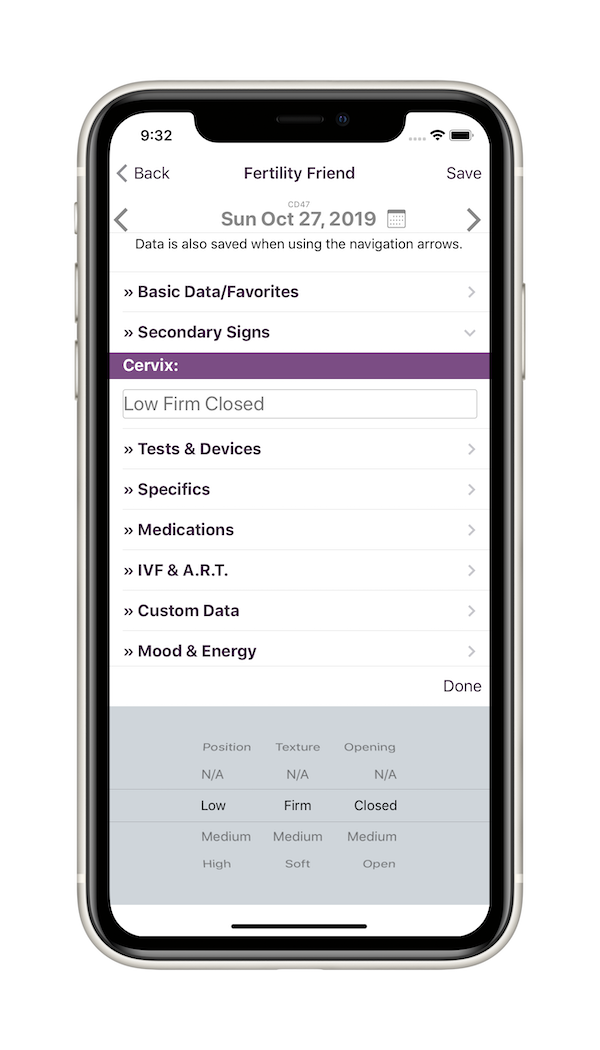
The data entry field for your cervix data on the web site is similar.
For more details about data entry using FertilityFriend.com please [Click Here].
Further Reading:
Next Lesson: Devices and Tests for Measuring Fertility Status.
Note: Please check this lesson within the app to access the lesson quiz.
© Tamtris Web Services Inc.
Terms Of Service || Privacy Policy || Contact